Severe Service: Why UAE Driving Can Shorten Your Car's Maintenance Intervals
By the PartMate team7 min read
In this article
Open your car's service book and you will usually find two schedules: a normal one, and a second one for "severe" or "special operating conditions". Most owners follow the first without reading the second. In the UAE that is often the wrong choice, and not because anyone drives unusually. School runs in heavy traffic, idling with the air conditioning on, dust in the air and the occasional weekend in the dunes are exactly what car makers mean by severe use.
What car makers mean by "severe"
The wording differs by brand, but the lists are strikingly similar. Hyundai's 2026 general-market manual lists, among others:
- repeated short trips of less than 8 km;
- extensive idling or long distances at low speed;
- driving on rough, dusty, muddy or unpaved roads, and in heavy dust;
- heavy traffic and frequent stop-and-go driving;
- towing, camping or carrying a load on the roof;
- taxi or other commercial use.
Toyota's GCC distributor in Oman gives a near-identical list: dusty roads, towing, a camper or roof carrier, trips under 8 km, and extensive idling or low-speed driving.
Nissan's schedule for the Patrol goes furthest for this region. It adds "areas where ambient temperatures are either extremely low or extremely high" and driving "in the desert".
Does it apply to you?
Here the brands differ, and it matters:
- Hyundai and Kia are strict: if any of the conditions apply, you must follow the severe schedule.
- Toyota applies it when you mainly drive under those conditions.
- Ford says plainly that occasional use under them does not require the extra maintenance.
Be honest about a normal week. If most of your driving is short city trips, queues on Sheikh Zayed Road or Emirates Road, and a car that sits idling with the air conditioning running while you wait, you are a severe-service driver by most manufacturers' definitions. The same goes if you regularly tow a boat, carry a roof load to the mountains or spend winter weekends on sand. A car that mostly does long, steady motorway runs between emirates may fit the normal schedule even here.
What changes in the schedule
The difference is not small. From the official manuals and service schedules:
- Engine oil and filter.
- Kia's Middle East schedule: every 10,000 km or 12 months under normal use, and every 5,000 km or 6 months under severe use.
- Hyundai, 1.6 turbo engine: the same 10,000 against 5,000 km.
- Toyota Oman, petrol cars: 10,000 km or one year normally, and 5,000 km or six months under special conditions.
- The Nissan Patrol: from 15,000 km to 7,500 km or six months.
- Engine air filter.
- Hyundai and Kia already specify a replacement every 15,000 km or 12 months for the Middle East, against every 45,000 km elsewhere.
- Toyota's dusty-road schedule adds an inspection every 2,500 km.
- Where Nissan says "more frequently", it defines that as less than half the normal interval.
- Cabin air filter: replaced more often in dust, according to Hyundai and Kia.
- Battery: Hyundai and Kia list a Middle East inspection every 10,000 km or six months.
- Brakes: Toyota's dusty-road schedule inspects pads and discs every 5,000 km or three months. Nissan checks brakes, steering and suspension every 7,500 km.
- Automatic transmission fluid: Nissan's Patrol schedule changes it every 30,000 km or 24 months when towing or driving in the desert.
Your own manual is the authority for your car. Look for the column or footnote headed "severe", "special operating conditions" or "Middle East".
Why 10,000 km became the UAE norm
For years, many UAE dealers serviced cars every 5,000 km. In 2015 the Ministry of Economy announced that cars should be serviced every 10,000 km instead, and dealers changed their schedules. Al-Futtaim Motors and Nissan both moved to 10,000 km.
That figure is the normal schedule. It does not cancel the severe one. A car that genuinely meets the severe conditions still needs the shorter intervals its maker specifies.
Dust: the part you will not notice at the pump
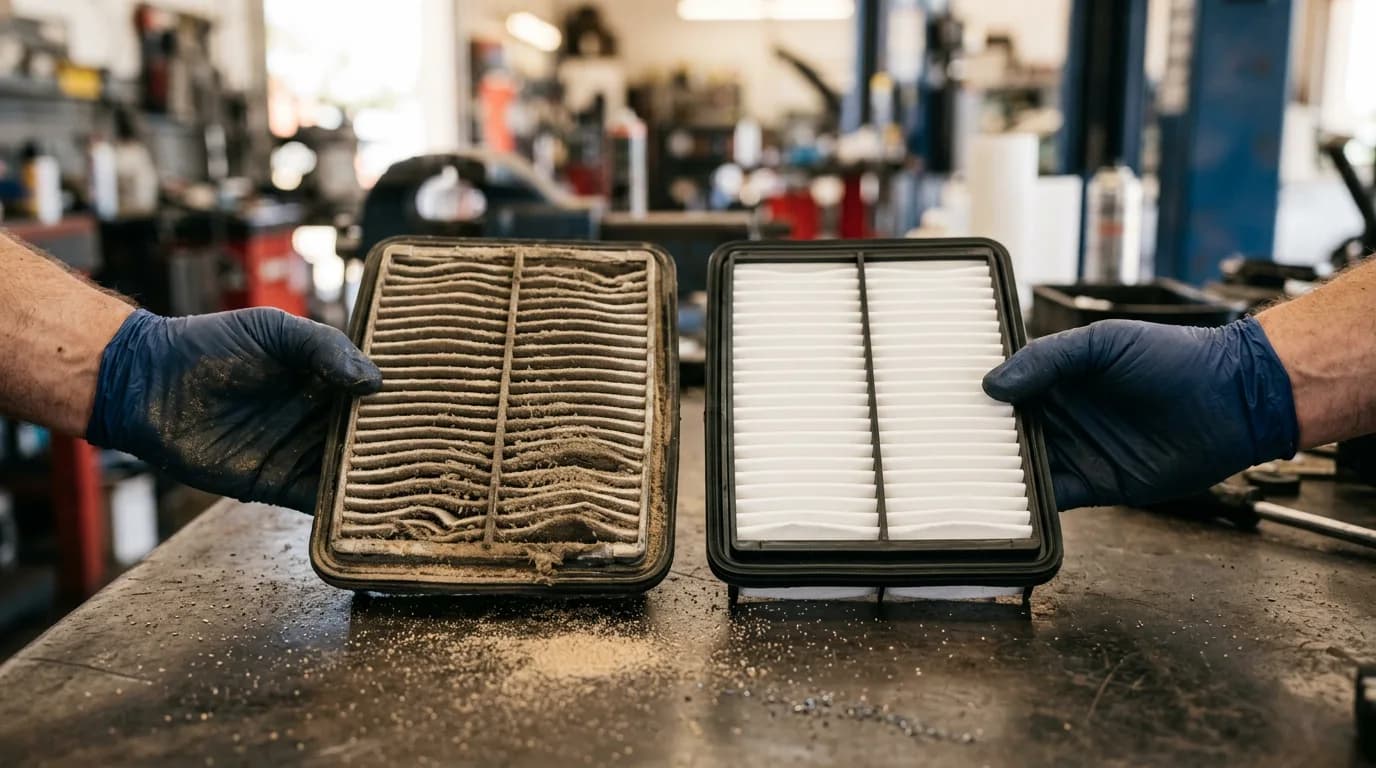
Fine sand is the UAE's particular enemy. A clogged engine air filter on a modern fuel-injected engine does not raise fuel consumption, according to the US Department of Energy, so you will not see it in your fuel bill. What it does cost is power. In tests at Oak Ridge National Laboratory, a clogged filter added 0.6 to 1.7 seconds to acceleration from 20 to 80 mph.
Because nothing warns you, the only way to know is to look. Check the filter at every service and after any sandstorm or desert trip.
The cabin filter matters too: it is what you breathe. Hyundai advises inspecting it more often and replacing it sooner on dusty roads. A musty smell or weak airflow from the vents is the usual sign. Sand carried in on shoes ends up in the cabin as well; fitted floor liners keep it out of the carpet.
Heat: batteries and cooling
Battery maker VARTA says it plainly: drivers blame the cold, but heat is what kills batteries. Chemical activity in a battery roughly doubles with every 10°C rise, so it wears out faster.
In a VARTA field test on Dubai taxis running around the clock, conventional batteries failed after about five to six months. That is an extreme case, but it explains why makers ask for a battery check every six months here.
The cooling system works harder too, which is why coolant level and condition belong on every service list. Our summer car care guide covers batteries, tyres and cooling in detail.
A sensible routine for UAE driving
If your driving fits the severe description, the manufacturer figures above suggest a routine along these lines. Your manual's own numbers come first.
- Oil and filter: at the severe interval, typically 5,000 to 7,500 km or six months, whichever comes first.
- Engine air filter: checked at every oil change and after sand or dust exposure, and replaced at least as often as the Middle East schedule says.
- Cabin filter: at least once a year, sooner after a dusty season.
- Battery: tested every six months, and before summer in particular.
- Brakes: pads and discs inspected at every oil change if you drive mostly in traffic or tow.
- After towing or desert driving: ask about transmission and differential fluids. Our guides to towing and desert driving cover the rest of the preparation.
Keep every receipt. It is your record that the car was maintained to the schedule its use required, which is what a dealer will ask about if a warranty question ever comes up.
Quick checklist
- Find the "severe" or "Middle East" column in your manual.
- Decide honestly whether your normal week fits it.
- If it does, shorten oil, filter and battery intervals to match.
- Look at the air filter after sand and dust. It will not warn you.
- Keep the service records.
Last checked on 5 November 2026.
Sources
- Hyundai — Maintenance under severe usage conditions and normal maintenance schedule (2026 general-market owner's manual, including Middle East rows), and climate control air filter.
- Kia — Maintenance under severe usage conditions and normal maintenance schedule (2024 regional owner's manual, Middle East intervals).
- Toyota Oman (Saud Bahwan Automotive) — Service interval and special operating conditions.
- Toyota Gibraltar Stockholdings — Vehicle maintenance (extract from the Toyota owner's manual: dusty-road intervals).
- Nissan South Africa — Patrol Wagon maintenance schedule (severe conditions including extreme heat and desert driving).
- Nissan USA — 2016 Service and Maintenance Guide (severe operating conditions).
- Ford — Scheduled Maintenance Guide (2009; special operating conditions, occasional use).
- US Department of Energy — Keeping your car in shape, and Oak Ridge National Laboratory — Effect of intake air filter condition on vehicle fuel economy (February 2009).
- AAA — Changing your car's engine air filter.
- VARTA — The temperature's effect on batteries (2020) and How summer heat affects a battery (2024; Dubai taxi test).
- AAA Club Alliance — Can the heat affect your car? (October 2023; cooling systems in hot weather).
- Gulf News — How often do you service your car? (September 2015; Ministry of Economy, 10,000 km) and Shift in car service frequency (December 2015; dealers move to 10,000 km).
PartMate sells car parts and accessories. This guide is general advice: your vehicle's owner's manual and your dealer's service schedule decide what your car needs, and following them matters for any warranty.
Not sure what fits your car?
Send us your make, model and year — we check fitment before you pay, and we would far rather answer a question than process a return.