Cloudy or Yellow Headlights? When to Restore Them and When to Replace Them
By the PartMate team5 min read
In this article
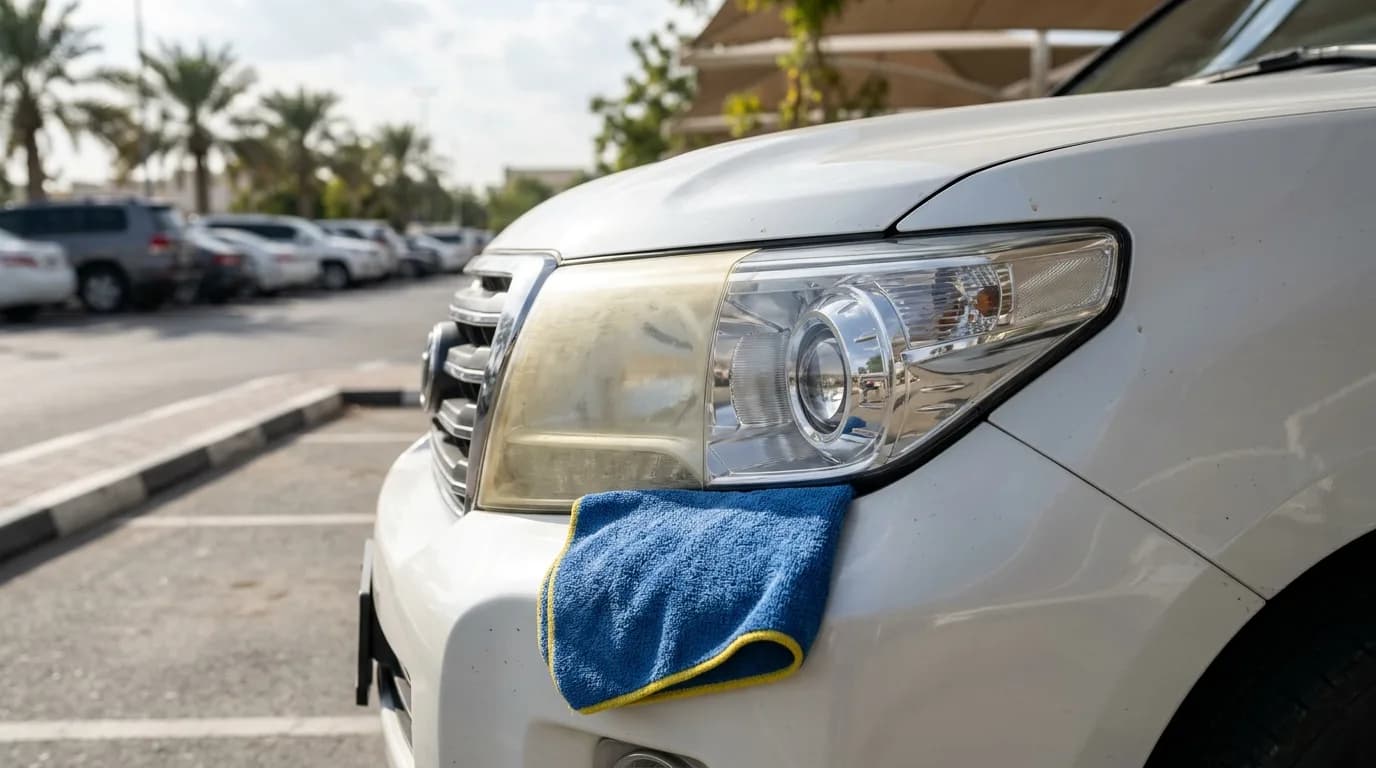
Look at the headlights of cars a few years old in any UAE car park and many have the same yellow, frosted look. It is not only cosmetic: a hazy lens scatters the light that should reach the road, so the car sees less at night and in fog, and other drivers see a glare instead of a clean beam. The good news is that a cloudy lens can often be restored. The bad news is that some damage cannot be polished away. Here is how to tell the difference.
Why headlights go cloudy
Modern headlight lenses are polycarbonate, not glass. It is light and shatter-resistant, but on its own it yellows in sunlight, so the factory applies a thin UV-resistant hard coat. Over the years that coat wears away. Strong sun, heat, sand blowing against the front of the car and harsh cleaning all speed it up, which is why the problem is so common here. Once the coat is gone, the plastic underneath oxidises and turns yellow and rough.
A two-minute check: outside or inside?
- Run a finger over the lens. If it feels rough or chalky and a damp cloth briefly makes it clearer, the haze is on the outside surface. That is the kind a restoration can fix.
- Look into the lamp. Haze, droplets or a fog line inside the lens, or a reflector that looks brown, burnt or peeling, is internal damage. Polishing the outside will not touch it.
- Look for cracks and chips. Stone chips and cracks let water and dust in, and they get worse.
- Check the mounting tabs. A lamp that moves when you push it gently has broken tabs and will not hold its aim.
What a proper restoration involves
A real restoration removes the damaged layer and then replaces the protection that was lost:
- The surrounding paint is masked.
- The lens is wet-sanded, starting with a coarser grit and working up to very fine ones, until the yellow layer is gone and the surface is evenly matte.
- It is polished back to clear.
- A UV-resistant clear coat or sealant is applied. This step is the one that matters most.
Skip the last step and the bare plastic starts to oxidise again straight away. Detailers commonly report the haze returning within months. With a good UV coating, most estimates put a restoration's life at roughly one to three years, at the shorter end in strong sun. These are industry estimates rather than test results, so plan to re-check the lenses every year.
Quick fixes such as toothpaste or a polish on its own can make a lens look better for a few weeks, but without the protective coat the yellowing comes back.
When to replace instead
Restoration is worth trying when the damage is only on the surface. Replace the headlight assembly when:
- there is haze, condensation or water inside the lamp;
- the reflector or projector inside is burnt, brown or peeling;
- the lens is cracked, or the mounting tabs are broken;
- the lens has already been restored several times, since each sanding removes material;
- you want a different light: a projector or LED unit in place of an old reflector halogen.
Replace headlights in pairs. A new lamp next to an old one never matches in colour or brightness, and the difference is obvious at night.
The rules: lights must work
Under Ministerial Resolution No. 178 of 2017, as reported by Gulf News, driving with vehicle lights that do not work carries a fine of AED 400 and six black points. Indicator or rear sign lights that do not work carry AED 400 and two black points. Not using headlights at night or in fog is a separate offence, with a fine of AED 500 and four black points.
These are not rare offences. Khaleej Times reported Ministry of Interior figures of 34,811 faulty-lighting violations in 2024, and roughly 30,000 violations for driving at night without headlights. At the annual technical inspection, the lights are checked too: our inspection guide covers what is tested. If a lens is badly clouded, ask the testing centre before your appointment whether it will pass.
After fitting: aim the beams
A new or refitted headlight has to be aimed. Too high, and it dazzles every driver coming towards you. Too low, and it lights only the first few metres of road. Most garages check the aim with a beam-setting tool in a few minutes. Do it again after fitting a heavy bumper, a lift kit or a roof load, since all of them change the angle.
Keeping lenses clear for longer
- Park in the shade or under a cover whenever you can.
- Rinse sand off with plenty of water before you wipe, so you are not scrubbing grit across the lens.
- Avoid harsh chemicals and abrasive pads on the lenses.
- Ask your detailer about a clear protection film or a ceramic coating made for lenses.
- Avoid tinted or smoked film: it cuts the light output you are trying to restore. Our guide to modifying your car legally in the UAE covers what is allowed.
Choosing replacement headlights
Fit depends on the exact model, year and generation, so match all three before you order. Then decide what you want the new lamps to do:
- A like-for-like replacement restores the original look, for example a Camry 2015–2017 headlight assembly pair.
- An LED or projector upgrade changes the beam, such as LED projector headlights for the Land Cruiser LC200 or full-LED headlights for the 2024–2026 F-150. Our LED headlight buying guide explains beam patterns, plugs and how to avoid lamps that dazzle.
Browse every model in Headlights. If your car is not listed, send us your VIN through a part request and we will confirm the fit first.
Sources
- Gulf News — Car headlights not working properly? These are the fines you face (July 2021; Ministerial Resolution No. 178 of 2017).
- Khaleej Times — 30,000 motorists fined for headlight violations in 2024 (July 2025; Ministry of Interior figures).
- Benchmark Abrasives — Headlight restoration that lasts: grits, coatings and real-world durability (restoration steps and durability estimates).
PartMate sells parts and accessories. Fines are quoted from the sources above and can change. Check the Ministry of Interior or your emirate's police for current figures.
Not sure what fits your car?
Send us your make, model and year — we check fitment before you pay, and we would far rather answer a question than process a return.