
Child Car Seats in the UAE: The Law, the Right Seat for Each Age and How to Fit It
By the PartMate team8 min read
In this article
Most parents in the UAE own a child seat. Far fewer use one on every trip. A 2026 RoadSafetyUAE survey found that 72 per cent of parents with children under four have a proper seat, but only 52 per cent said their child always uses one in a taxi, a limousine or a friend's car. The short trips are where children get hurt, so here is what the law asks of you, which seat suits which age, and how to fit it so it actually protects.
What the law says today
Two rules in the federal fines table apply to every driver in every emirate:
- A child under four must ride in a child safety seat. Not fixing a seat for a child under four is a fine of AED 400.
- A child under ten, or anyone shorter than 145 cm, may not sit in the front. Allowing it is also AED 400. The Arabic wording, which Sharjah Police repeated in July 2026, says "ten or under", so treat a child's tenth birthday as still too young.
Note that the 145 cm rule is about height, not age. A small eleven-year-old still belongs in the back.
Published reports differ on black points. The official table lists no black points for either offence, while several police reminders quoted in the press mention four. The fine itself is not in doubt. Abu Dhabi has also gone further under its own vehicle seizure law: in 2021 and 2022 its police reported impounding cars with small children in the front, with AED 5,000 to release them. Check the current position with Abu Dhabi Police if you drive there.
What changes on 1 January 2027
On 4 November 2026 the UAE announced the implementing regulations of the federal traffic law (Cabinet Decision No. 174 of 2026). They take effect on 1 January 2027. As reported by The National, Article 11 says:
- Drivers must provide an appropriate child safety seat for children aged four and under.
- The seat must match the child's weight and height, be installed in the rear seats, and meet the national standards.
- In a vehicle with no rear seats, the child seat may go in the front only if it faces backwards and the airbag is switched off.
- A child whose medical condition prevents using a seat is exempt, with an official medical certificate and an adult sitting with the child in the back.
In practice: a four-year-old who has just had a birthday still needs a seat, and a seat bought on a guess about size will not do. Pick-up drivers with a single cab should read the airbag rule twice.
The right seat for each stage
Age is a rough guide. Your child's height and weight against the limits printed on the seat decide when to move up.
- Rear-facing (birth to at least 15 months, longer if the seat allows). A rear-facing seat spreads crash forces across the back and head instead of the neck. The i-Size standard (UN R129) does not allow a child to face forward before 15 months. Paediatricians advise staying rear-facing for as long as the seat's height or weight limit allows. Abu Dhabi's public health centre goes further and recommends rear-facing up to four years or 18 kg.
- Forward-facing with a harness. Once your child outgrows the rear-facing limits, use a forward-facing seat with its own five-point harness, ideally to at least four years of age.
- Booster seat. A booster raises the child so the adult belt sits in the right place. Keep using it until the belt fits without it, which usually happens around 145 cm. That is the same height the front-seat rule uses.
- Adult belt, still in the back. International advice is to keep every child under 13 in the back seat, even after they leave the booster.
Buy a certified seat
Since March 2018, Cabinet Resolution No. 27 of 2017 has required every child seat sold in the UAE to carry a certificate of conformity with the national standard, with instructions in Arabic and English. Look for:
- the UAE conformity mark;
- a UN approval label, ECE R44 or the newer R129 (i-Size), which is based on the child's height rather than weight.
A seat bought abroad or online may carry neither.
Not every seat fits every car. If you can, try it in your own car before you pay. ISOFIX seats need the matching anchor points, and some seats will not fit every car that has them.
How to fit it properly
- Follow both manuals: the seat's and the car's. The car's manual shows the ISOFIX points and which seats are approved for child seats.
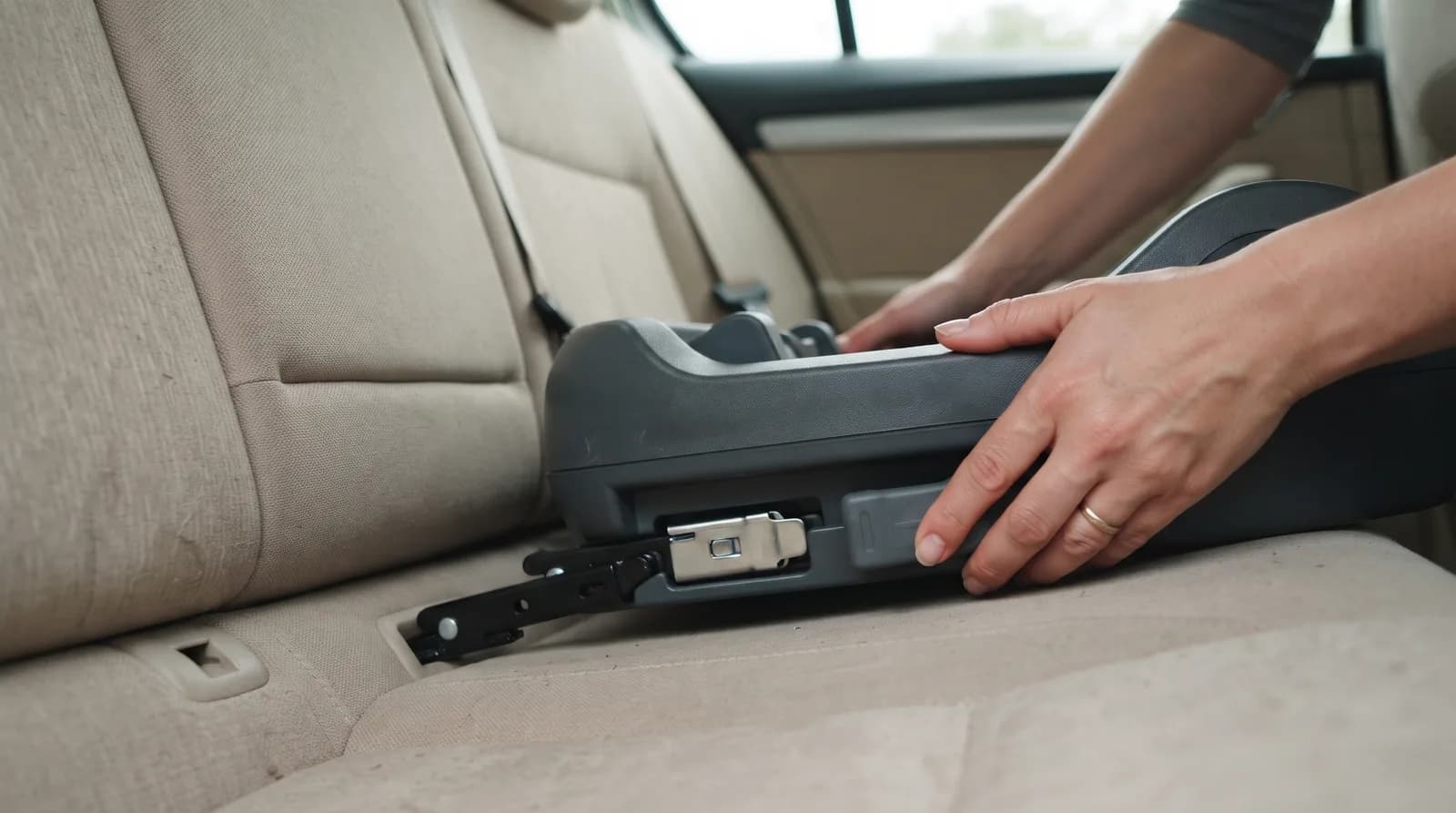
- ISOFIX or seat belt, done right. Both methods are equally safe when the seat is installed correctly. A forward-facing seat should always use its top tether or support leg, which stops the seat tipping or rotating in a crash.
- Never put a rear-facing seat in front of an active airbag. An airbag opening against the back of the seat can kill a baby. Abu Dhabi Police make the same point.
- Tight harness. If you can pinch a fold of the strap at your child's collarbone, tighten it. Only one or two fingers should fit between the harness and the chest. The buckle sits low, not over the tummy.
- No bulky layers under the straps. A thick jacket compresses in a crash and leaves the harness loose. Buckle up first, then put a blanket over the top.
- Booster belt check. The lap belt goes across the hips, not the stomach, and the shoulder belt crosses the shoulder, not the neck.
Second-hand seats and seats after a crash
A used seat may have been in a crash with damage you cannot see. UK road safety experts advise replacing a seat after a crash even when it looks perfect. In the UAE there is a second risk: plastic that has spent several summers in a parked car may have weakened.
If you do accept a seat from family, ask its history. Check the manufacture date on the label, and make sure the instructions and all parts are present. After any collision, add the child seat to your claim. Our guide to what to do after an accident covers the rest of the process.
Never leave a child in the car
A parked car in the sun can be 20 to 30°C hotter inside than out. A Sharjah test saw a rise of up to 30°C in ten minutes. Dubai Police rescued 107 children locked alone in vehicles in 2025.
Under the federal Child Rights Law (Wadeema's Law), a carer who leaves a child without supervision faces imprisonment or a fine of not less than AED 5,000. Some press reports say "up to" AED 5,000; the law's own wording is "not less than".
The simplest habit: put your phone or bag on the back seat, and check the back before you lock. Call 999 if you see a child alone in a car.
Long drives with children
Plan a stop every two hours so nobody has to be unbuckled while the car is moving. Keep the sun off the seat with a window shade, and touch the buckles before strapping your child in on a hot day: metal in the sun can burn.
A screen mounted on the back of the front headrest keeps older children occupied without a loose tablet flying around in a sudden stop. An example is our headrest monitor for the Land Cruiser LC200 and LC300.
Quick checklist
- Under four (and from 2027, four and under): a seat matched to weight and height, in the back.
- Under ten or under 145 cm: never in the front.
- Rear-facing as long as the seat allows, at least to 15 months.
- UAE-certified seat with an R44 or R129 label.
- Tether or support leg on forward-facing seats; no rear-facing seat in front of an airbag.
- Pinch test every trip, and a new seat after a crash.
Last checked on 5 November 2026.
Sources
- u.ae — Road safety (updated 1 October 2026; laws in force, including Federal Decree-Law No. 14 of 2024 and Ministerial Resolution No. 178 of 2017).
- Ministry of Interior — List of traffic offences and violations (items 49 and 50: AED 400 each).
- The National — UAE motorists face nine-hour driving limit from January (4 November 2026; Cabinet Decision No. 174 of 2026, Article 11 on child seats).
- Khaleej Times — Sharjah Police advisory on children in the front seat (25 July 2026).
- Khaleej Times — Child car seat standards rule comes into effect (11 March 2018; Cabinet Resolution No. 27 of 2017).
- Gulf News — Child riding in the front seat: the fine and Abu Dhabi impoundment (February 2021).
- Gulf News — Nearly a third of UAE parents still travelling without child car seats (May 2026; RoadSafetyUAE survey).
- Abu Dhabi Public Health Centre — Safety of Children in Vehicles guide (2024).
- American Academy of Pediatrics — Car seats: information for families (updated April 2026) and car seat safety tips (pinch test, bulky clothing).
- RoSPA — Choosing and using child car seats and types of seat (R44, R129 i-Size, ISOFIX, second-hand seats, replacing after a crash).
- Khaleej Times — When can a child sit in the front seat? Police clarify (December 2019; Abu Dhabi Police on rear-facing seats).
- Gulf News — Police warning: don't leave children in cars as temperatures soar (May 2025; Sharjah heat test, the AED 5,000 penalty).
- Federal Law No. 3 of 2016 (Wadeema's Law) — official English text (Articles 35 and 60).
- The National — Dubai Police rescue scores of children trapped alone in cars (11 June 2026).
PartMate sells car parts and accessories. This guide is general information, not legal advice: your child seat's manual and your car's manual decide how a seat is fitted, and the traffic authorities in your emirate decide how the rules are applied. Fines and rules can change; check the Ministry of Interior for the current position.
Not sure what fits your car?
Send us your make, model and year — we check fitment before you pay, and we would far rather answer a question than process a return.