
UAE Vehicle Technical Inspection: What Is Checked, Why Cars Fail, and How to Pass First Time
By the PartMate team · 14 September 2026
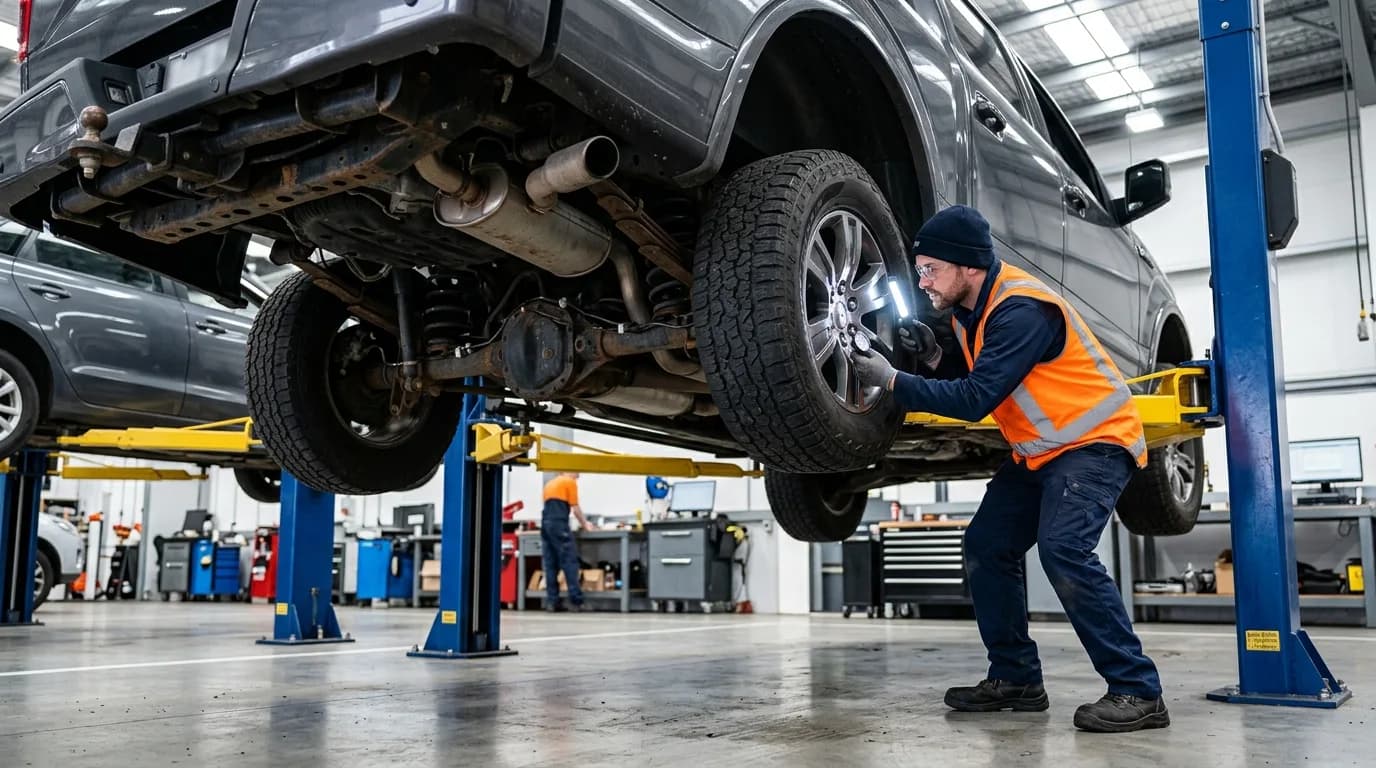
The technical inspection is where a year of small neglect turns into a re-test fee. It is also, if you know what the lane looks for, one of the easier things to pass first time. This guide sets out what the RTA says is checked, the rule that fails more cars than any other, how the booking works in Dubai, and a driveway checklist to run the evening before.
Last checked against the official pages on 14 September 2026. Fees and steps change; the linked page always wins over this article.
When the inspection is required
You need a passed inspection to renew the registration, to transfer ownership after a sale, and to export a vehicle with its plates. New vehicles get a break: the federal portal notes that the inspection applies to vehicles other than those produced in the last three years before registration. After that it is every year, at renewal.
The certificate the RTA issues is valid for 30 days, so the inspection is booked close to the renewal, not months ahead.
Booking in Dubai
The RTA’s Apply for Vehicle Inspection service asks you to book a mandatory appointment first — on the RTA website or in the RTA Dubai app:
- Log in with UAE Pass, or with your Emirates ID, licence, plate number or traffic file.
- Select the plate source (Dubai plates are verified through your account; other emirates’ plates need the details typed in).
- Select the vehicle and the inspection type, then the centre.
- Book the appointment and confirm; the details arrive by email and SMS.
- Bring the vehicle, pay the fee, and confirm your email to receive the certificate electronically.
The approved centres are spread across the emirate — Tasjeel (Al Barsha, Al Qusais, Al Twar, Al Warsan, Jebel Ali, Motor City, Hatta and more), Shamil (Al Qusais, Muhaisna, Nad Al Hammar), Wasel (Al Jaddaf, Al Khawaneej, Nad Al Hammar), AutoPro in Al Mankhool, Al Mumayaz, Al Mutakamela, AG Cars and others. The full list, with maps, is on the RTA service page linked below. In Abu Dhabi and the Northern Emirates the same kind of centres operate under the local traffic departments and the MOI.
What the lane checks
The RTA states the standard the vehicle has to meet:
- The tyres must be suitable for driving.
- The brake and lighting systems must be homogeneous and working properly.
- The interior and exterior of the body must not be eroded.
- All internal parts must function properly.
- The engine must run properly and efficiently with no sign of a fuel, lubricant or coolant leak from the bottom or sides.
The RTA’s published testing parameters go into the mechanics of it: exhaust emissions for petrol and diesel engines, service-brake condition and operation, parking-brake performance and efficiency, and visual checks of the steering, the field of vision and glass condition, the rear-view mirrors, the windscreen wipers and the suspension components.
The rule that fails the most cars: tyre age
The RTA is explicit: a vehicle will not pass the technical test if the tyres are expired — that is, their lifespan exceeded five years from the date of manufacture. The same applies to tyres that are seriously worn or have cuts, and certain tyre types — mountain and snow tyres — are not fit for public roads here at all.
Read the age off the sidewall. Every tyre carries a DOT code ending in four digits: the week and the year of manufacture, so 2321 is the 23rd week of 2021 — and a tyre made in 2021 fails an inspection in 2026 however good it looks. Buying tyres, check that code before you pay: a “new” tyre that sat in a warehouse for two years has already lost two of its five.
The driveway checklist
Ten minutes the evening before saves a re-test:
- Tyres: DOT date under five years on all four (and the spare, if fitted), no cuts or bulges, tread across the full width, pressures to the door-jamb label.
- Lights: every bulb — headlights on both beams, indicators, brake lights (get someone to press the pedal), reverse, fog, number-plate lamps. Aftermarket headlights must be a proper road-legal unit with a correct beam cut-off; a housing that dazzles will be noticed on the lane.
- Glass and tint: no cracks in the driver’s field of view; tint on side and rear windows within the permitted limit, nothing on the front windscreen (see our tint and modifications guide).
- Leaks: look under the car after it has stood overnight. A patch of oil or coolant is exactly what the RTA lists as a fail.
- Brakes and handbrake: the car should stop straight, and the parking brake should hold it on a slope.
- Wipers, washer, horn, mirrors: all working, all present.
- Body: no sharp or loose panels, no rust-through. A well-fitted body kit or bumper is fine; a cracked one hanging off its clips is not.
- Warning lights: an engine-management light on the dash invites a closer look at emissions.
If the car fails
You get a report listing the points that failed, you fix them, and you re-test. Most re-tests are for tyres and lights — the two things that are cheapest to check in advance and most expensive to discover on the day.
Sources
- RTA Dubai — Apply for Vehicle Inspection: booking steps, the 30-day certificate, the list of approved centres.
- RTA Dubai — Field inspection of vehicle tyres in Dubai: the five-year tyre rule, worn or cut tyres, unsuitable tyre types.
- RTA Dubai — Vehicle Testing by RTA (testing parameters): emissions, brakes, steering, visibility, wipers, suspension.
- UAE Government portal (u.ae) — Registering vehicles: the inspection requirement and the new-vehicle exemption.
PartMate stocks road-legal lighting, bumpers, body kits and running boards for American and Japanese trucks and SUVs; if a part is going on before an inspection, ask us whether it carries the certification the lane expects. This article summarises public government information; it is not legal advice.
Not sure what fits your car?
Send us your make, model and year — we check fitment before you pay, and we would far rather answer a question than process a return.