Car Batteries in UAE Heat: How Long They Last, How to Test One and When to Replace It
Heat, not cold, wears out a car battery, and the failure often shows up in autumn. How long one lasts in the UAE, how to test it, and how to choose and fit a replacement.
In this article
Most drivers expect a battery to fail in winter. In the UAE the damage is done in summer and often shows up now, as the mornings cool. Gulf News reported in July 2026 that a battery damaged in July may keep starting the car, because a hot engine needs less cranking power, and then fail once temperatures ease in autumn. November is a good month to test yours.
Why heat shortens a battery's life
Battery maker VARTA is blunt: drivers blame the cold, but it is heat that causes failure. The reasons:
- Chemical activity inside a battery doubles with every 10°C rise, so it ages faster.
- Heat corrodes the lead grids inside, and that damage is permanent.
- Heat speeds up self-discharge. GS Yuasa says a 10°C rise in battery temperature doubles the rate, which matters when a car stands for weeks.
VARTA's field test shows the extreme. On 60 Dubai taxis driven about 19 hours a day, battery temperature was above 60°C for 80% of the time, and every conventional battery failed after about five to six months.
How long a battery really lasts here
Published figures disagree, partly because climates differ:
- United States: three to five years, says the AAA. Consumer Reports quotes its regional figures as 58 months or more in the far north and under 41 months in the far south.
- United Kingdom: the RAC says three to five years. The AA gives three to five on one page and five to seven on another.
- UAE: Bosch Car Service says most last around two to three years, and that in cooler countries they can last twice as long.
Khaleej Times reported in July 2026 that dubizzle's inspection team, across more than 20,000 inspections, found about 14% of cars with battery health below 30%. Thrifty Car Rental told the paper it sees 25 to 35% more battery-related service requests in summer than in the cooler months.
So plan on two to three years. The AAA advises a yearly test once a battery is two years old.
Warning signs
- The engine turns over slowly.
- The battery warning light stays on or flashes.
- Headlights dim, or interior lights flicker.
- A clicking sound when you turn the key.
- The battery goes flat again soon after a charge or a jump start.
Test it: resting voltage first
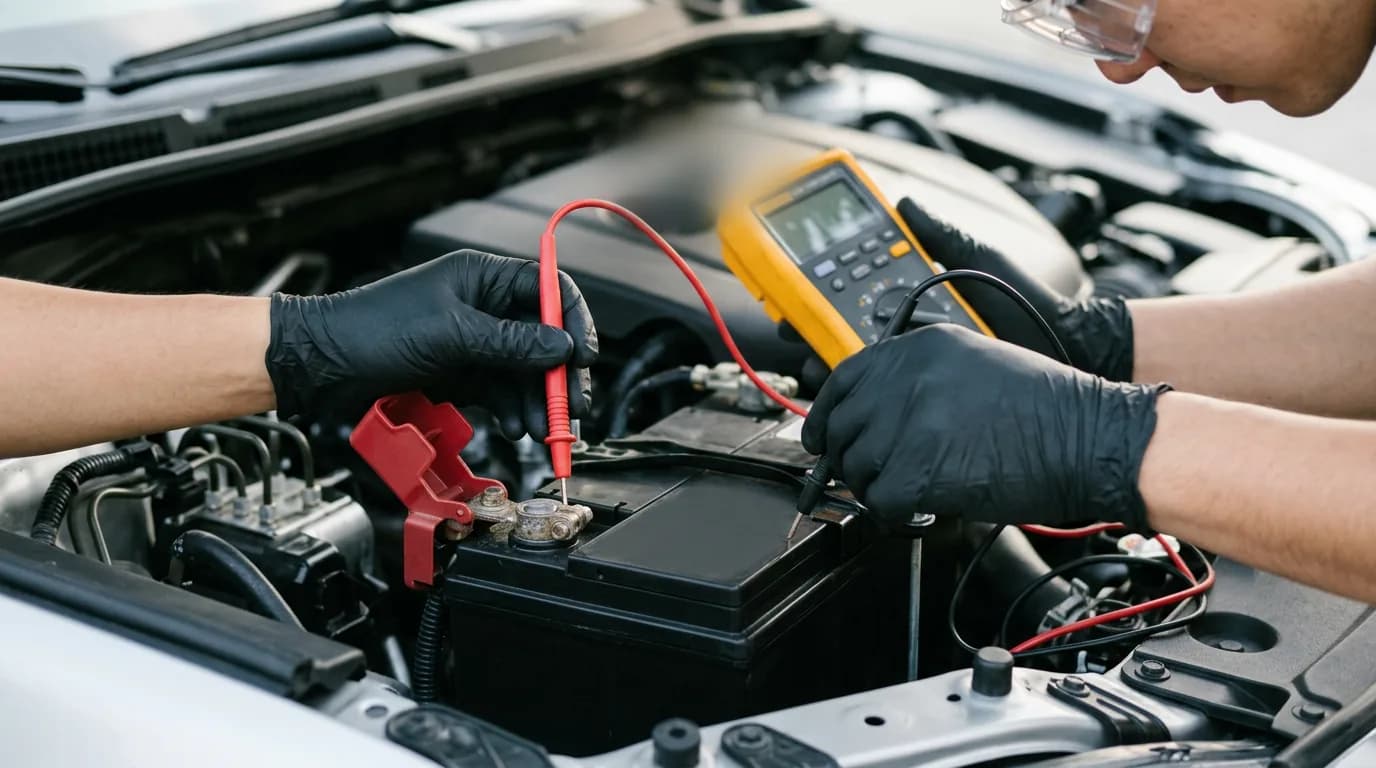
A multimeter shows how charged the battery is:
- Switch everything off and let the car rest. Kwik Fit suggests 15 to 30 minutes. Battery maker Optima adds that 30 seconds of headlights removes the surface charge left by driving or charging.
- Set the meter to DC volts. Put the red probe on the positive (+) terminal and the black probe on the negative (−).
- Read it. About 12.6 V is fully charged. On Kwik Fit's table, 12.5 V is about 90%, 12.2 V about 60% and 12.06 V about 50%. Tables differ slightly between makers, and some battery types read higher.
- Start the engine. The reading should rise to between 13.5 and 14.7 V, which shows the alternator is charging.
Then a load test
Voltage shows charge, not whether the battery can still deliver current. A load test does. Battery maker Discover describes the method: apply a load equal to half the battery's cold cranking amps (CCA) for 15 seconds, and the voltage should stay above 9.6 V. A battery below 75% charge is recharged first. One that fails is recharged and tested again, and replaced if it fails twice.
It needs a load tester, so ask a workshop and keep the printout.
What drains it
- Short trips. The AA says a drive of 30 minutes or more helps the battery recharge.
- Standing still. VARTA advises charging every two months if a car is used only now and then. The AA notes that EFB and AGM batteries need a smart charger.
- Accessories. Heavy use of lights, audio and air conditioning drains the battery faster, the AA says. Use light bars and other extra lamps with the engine running.
- Dash cams in parking mode. A hardwired camera keeps drawing power while parked. BlackVue's manual describes the safeguard: a low-voltage cut-off that switches the camera off when the battery falls below a set level, 12.0 V by default on a passenger car. If you fit a camera with a parking monitor, such as our mirror dash cam, ask the installer how it is powered when parked and whether it has a cut-off.
Choosing a replacement
- Size and terminals. Match the original. The handbook or the old battery's label gives the size, which fixes the dimensions and terminal layout.
- CCA. The amps a battery delivers for 30 seconds at −18°C (0°F) while holding at least 7.2 V. It is a cold-start figure; Clarios, VARTA's parent, advises matching it to climate, vehicle and the car maker's specification.
- Start-stop cars. VARTA's rule: an AGM battery is replaced with an AGM, an EFB with an EFB or an AGM. A conventional battery deteriorates quickly in these cars.
- Heat. Makers disagree. Clarios recommends AGM for high-temperature environments, and the AGM batteries in the Dubai taxi test lasted all 12 months. Banner says EFB is the more heat-resistant type beside the engine, and that an AGM must not sit in more than 55°C. The safe course is the type the car maker fitted, in the place it fitted it.
- Freshness. Consumer Reports advises buying a battery less than six months old, ideally under three.
Replacing it safely
On a start-stop car, VARTA advises against doing it yourself. The job can take up to 28 steps, the battery may be in the boot or the cabin, and the new one has to be programmed into the car's energy management system. The RAC says many modern cars need battery registration or an electronic reset afterwards.
On a simpler car, the AA and the RAC describe the same routine:
- Wear gloves and eye protection. Take the key out.
- Disconnect the negative (−) terminal first, then the positive. Keep the cables away from the terminals.
- Undo the clamp and lift the battery out carefully.
- Fit the new one the same way round and refit the clamp.
- Connect the positive first, then the negative.
Never put the old battery in household waste: it contains lead and acid. Hand it to the retailer or garage for recycling.
See also our summer car care and severe-service guides, and the pre-trip check before a desert drive.
Sources
- VARTA (Clarios) — Temperature and batteries, summer heat and the Dubai taxi test, start-stop replacement and changing an EFB or AGM battery (undated).
- GS Yuasa, via Autobiz — Summer battery checks (June 2024).
- Bosch Car Service UAE — Car battery replacement (undated).
- AAA — Car battery types (undated); Consumer Reports — Hot weather and your car battery (May 2019).
- RAC — How long do car batteries last? and How to change a car battery (September 2026).
- The AA — Flat battery (January 2024) and How to replace a car battery (April 2025).
- Gulf News — Parked cars in UAE summers (July 2026).
- Khaleej Times — dubizzle inspection findings (16 July 2026) and Thrifty on summer battery faults (17 July 2026).
- Kwik Fit — Car battery voltage (July 2023); Optima — Measuring battery voltage (September 2020).
- Discover Battery — Load testing (undated).
- Clarios — AGM, EFB and flooded batteries (February 2026) and Cold cranking amps; Banner — Upgrading EFB to AGM (undated).
- BlackVue — Manual: parking mode and battery protection (undated).
PartMate sells car parts and accessories. This guide is general advice: your vehicle handbook and the battery maker's instructions come first. A battery holds acid and can deliver a very high current, so if you are unsure, leave testing and replacement to a qualified workshop.
Parts in this guide
All 6 off-road lights

Not sure what fits your car?
Send us your make, model and year — we check fitment before you pay, and we would far rather answer a question than process a return.