
Dash Cams in the UAE: What the Law Says and How to Choose and Fit One
Fitting a dash cam is legal in the UAE, but posting its footage can break the privacy law. What the law and the police say, and how to choose and fit a camera that survives the heat.
In this article
A dash cam can settle an argument in one clip: who changed lane into whom. Fitting one is legal in the UAE. What you do with the footage is where the law gets strict. Here is what the law and the police say, and how to choose and fit a camera that survives a Gulf summer.
Is a dash cam legal in the UAE?
Yes. Maj Gen Mohammed Saif Al Zafeen of Dubai Police, then chairman of the Federal Traffic Council, said in 2017: "There is no law in the UAE that criminalises the installation of dash cameras." In April 2024 Khaleej Times reported the same Dubai Police position, with one condition: do not breach other road users' privacy. We found no newer official statement that changes this.
What the privacy law says
The rule that matters is Article 44 of Federal Decree-Law No. 34 of 2021 on rumours and cybercrimes, in force since 2 January 2022. It punishes anyone who uses electronic means with the intention of invading another person's privacy without consent. The acts it lists include:
- taking photos of other people in any public or private place, or transferring, disclosing or keeping them;
- recording or revealing conversations and audio or video material;
- publishing photos or scenes, even if true, with the intention of harming someone;
- taking or publishing photos of the injured, the dead or accident victims without consent.
The penalty is imprisonment for at least six months and/or a fine of AED 150,000 to AED 500,000. Some press reports say "up to" six months; the law's wording is "at least".
Lawyers quoted by The National in 2017 disagreed on how far this reaches. One said recording the road is allowed unless the footage is used to defame someone. Another said filming a pedestrian already breaches privacy. The safe reading:
- Never post footage that shows faces, number plates or a crash, however badly the other driver behaved.
- Share it only with the police and your insurer.
- A cabin camera or microphone records your passengers. Tell them, or switch it off.
Using footage after an accident or for a report
- After a crash. Report it through the emirate's official channel (see our accident guide) and say you have a recording. Gulf News reports that the authorities can validate footage and use it in an accident investigation if it is clear and shows the incident accurately. The police still decide who is at fault.
- Save the clip first. Loop recording overwrites the oldest files when the card is full.
- Dangerous driving in Dubai. Use Police Eye in the Dubai Police app (choose Traffic Reports; a video can be attached) or call 901. Dubai roads only.
- Disputing a fine. Gulf News lists the routes: the Abu Dhabi Police e-complaints portal; in Dubai, the traffic headquarters in Al Barsha or the Dubai Public Prosecution website; elsewhere, the Ministry of Interior app. See our fines guide.
- Do not film with your phone while driving. The federal fines table lists AED 800 and four black points for using a phone or being distracted, and AED 1,000 for crowding at an accident scene.
How to choose one
- Front and rear. A front-only camera misses a hit from behind. A two-channel camera records both views.
- Resolution. Dash cams come in 1080p, 2K and 4K. Consumer Reports found that 4K keeps the most detail, such as number plates, and that 1080p can look grainy at night. Gulf News' buying guide adds that a good image sensor matters more than the number on the box.
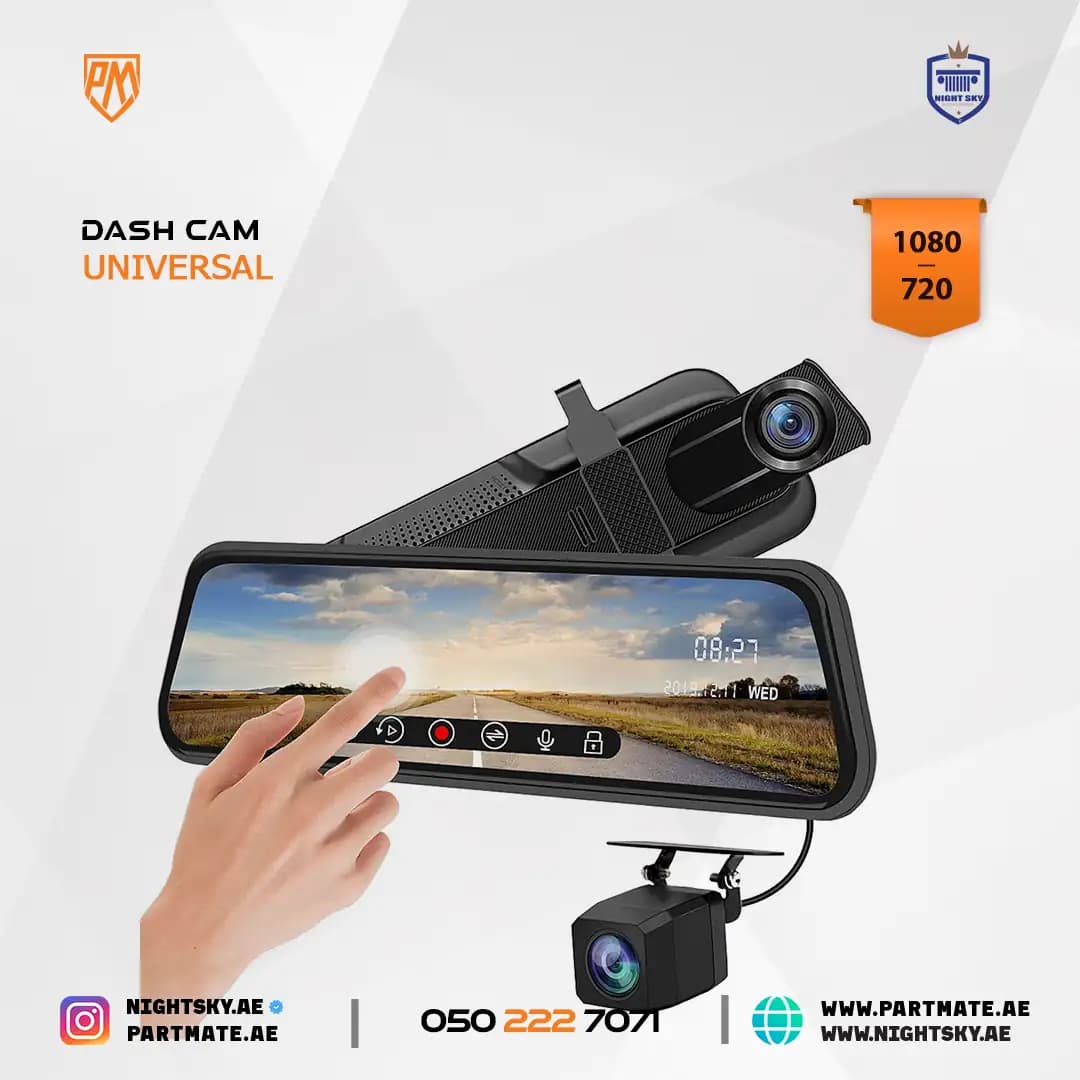
- Mirror type. A mirror dash cam combines the interior mirror and the recorder in one unit, and its screen shows the rear camera live. Our 10-inch mirror dash cam records front and rear in 1080p, with loop recording, a parking monitor and a waterproof rear camera. See our interior accessories.
- Memory card. Constant rewriting wears out ordinary cards. Buy a high-endurance microSD card of Class 10 or higher, in the largest size the camera accepts.
Heat: the UAE test
Khaleej Times, citing road safety experts, reported in August 2026 that a car parked in the summer sun can quickly reach 60°C or more. Now read a manual: the Thinkware U3000, for example, is rated to operate up to 60°C and to be stored up to 70°C. A camera left recording in a parked car in August may be working beyond its rating.
- Check the operating temperature before you buy.
- Prefer a supercapacitor to a lithium battery in a hot climate, though capacitors are not immune to heat.
- Abu Dhabi Police's 2026 summer campaign lists batteries and energy storage devices among things not to leave in a hot car.
Parking mode and battery drain
Parking mode records when the camera detects motion or an impact with the engine off. It usually needs a hardwire kit to the fuse box, not the 12V socket. That draws on the car's battery, so:
- choose a kit with a low-voltage cut-off and switch battery protection on;
- disconnect the camera if the car will sit for many days, as Consumer Reports advises;
- look after the battery: the RAC says a healthy one should see little effect, and our summer car care guide covers battery life here.
Fitting it
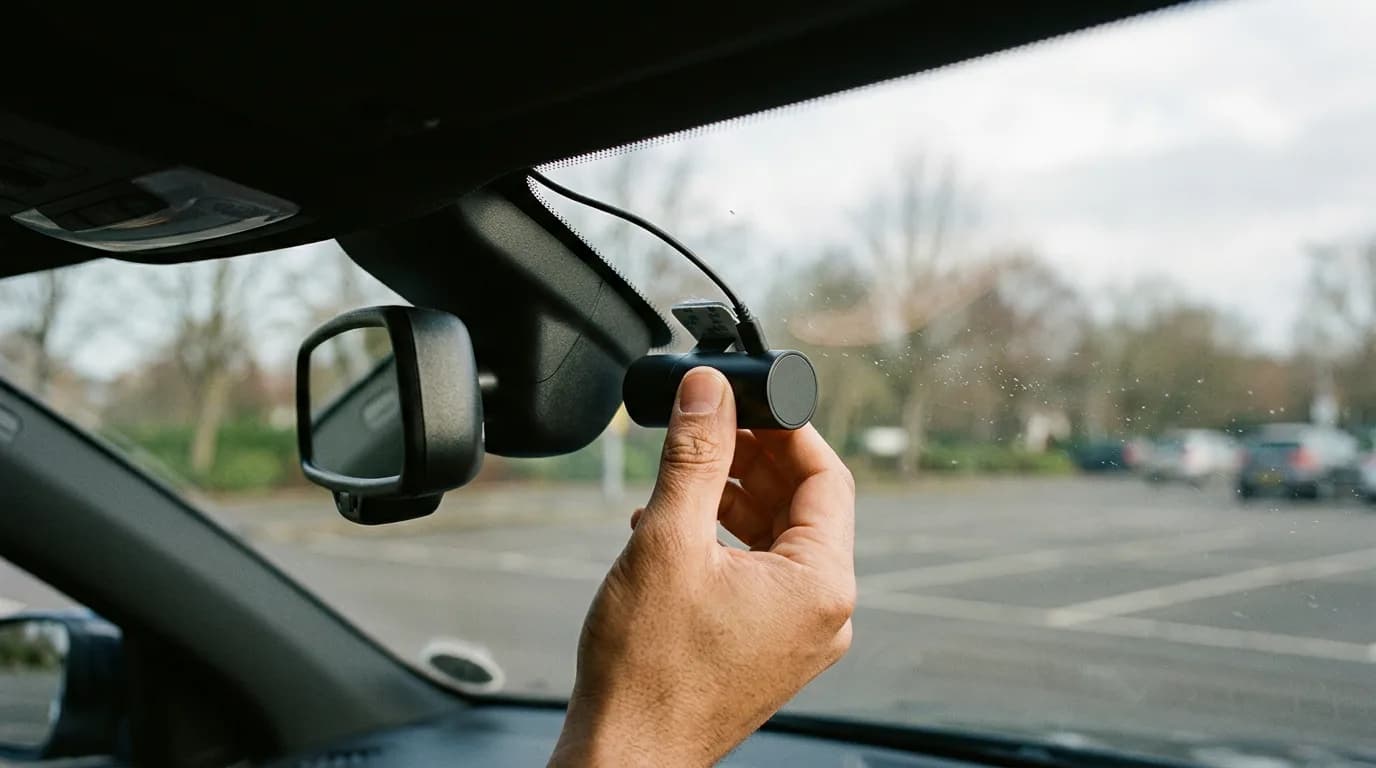
- Position. Mount it behind the interior mirror on the passenger side, inside the area the wipers sweep, where it does not block the driver's view, and off the black dotted band. We found no UAE rule that names a position for a dash cam.
- Screen. Set it up before you move off. Federal regulations that start on 1 January 2027 repeat that drivers must not use phones or other electronic devices unlawfully.
- Cables. Run them along the top of the windscreen and down the side. Curtain airbags sit along the roof rails and pillars: never attach a cable to an airbag or assume a hidden wire is clear of one. If the route passes an airbag or trim has to come off, use a qualified installer.
- Warranty. A lawyer told Gulf News in 2025 that a dash cam alone does not cancel a warranty: under Federal Law No. 15 of 2020 on consumer protection, the dealer must prove the accessory caused the fault. Use a licensed installer and keep receipts.
Last checked on 7 November 2026.
Sources
- Federal Decree-Law No. 34 of 2021 — English text (20 September 2021; Article 44; copy hosted by Abu Dhabi Global Market).
- Ministry of Interior — List of traffic offences (Ministerial Resolution No. 178 of 2017; items 32 and 74).
- The National — Police boss backs dash cams for crash disputes (31 July 2017).
- Khaleej Times — Dash cam sales soar (10 April 2024) and parked cars can hit 60°C (5 August 2026).
- Gulf News — dashcams and disputing fines (updated 20 September 2026); photos of accident victims (2 March 2022); Police Eye and 901 (9 February 2024); dash cams and warranty (11 September 2025); Abu Dhabi Police summer warning (20 June 2026); what to look for in a dash cam (28 July 2026); 2027 traffic regulations (4 November 2026).
- Consumer Reports — How to choose a dash cam (updated 14 September 2026).
- RAC — Dash cam guide (17 May 2023). Nextbase — How to install a dash cam (20 January 2017).
- BlackboxMyCar — supercapacitors and batteries (quotes the Thinkware U3000 manual), parking mode and dash cams and airbags (undated).
- Garmin — memory card specifications (undated). VIOFO — why high-endurance cards matter (24 November 2025).
PartMate sells car parts and accessories. This guide is general information, not legal advice: your camera's manual and your car's manual decide how it is fitted, and the police and courts in your emirate decide how the law is applied. Laws and fines can change; check with the police for the current position.
Parts in this guide
All 58 interior accessories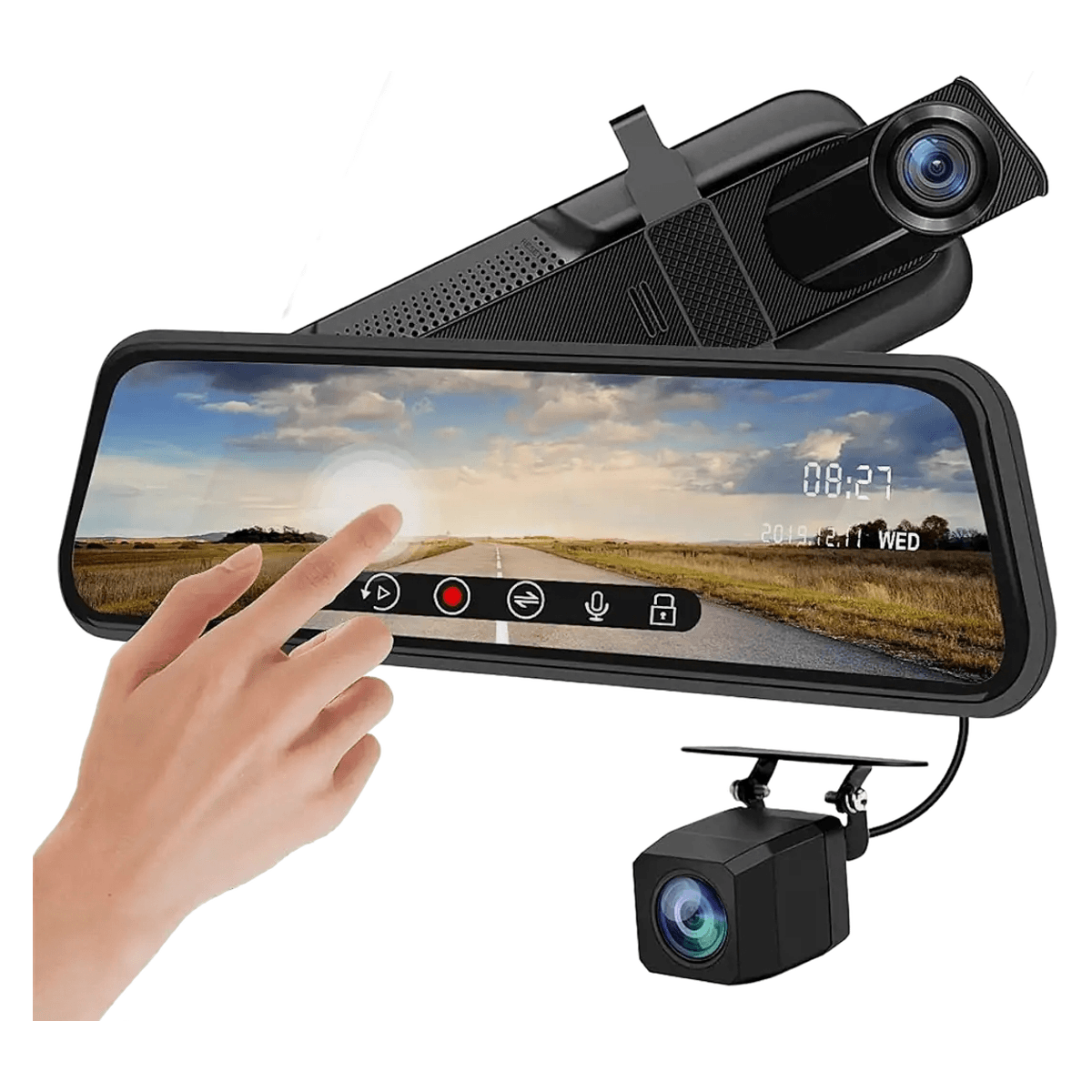
Not sure what fits your car?
Send us your make, model and year — we check fitment before you pay, and we would far rather answer a question than process a return.
Keep reading
 Buying Guides8 min readGiving Your Ford F-150 the Raptor Look: What a Conversion Kit Changes and What It CannotBuying Guides7 min readWinter Camping in the UAE: Setting Up Your 4x4, and the Rules Campers Must Know